Generative Art with Context Free
I’ve got a small repo, ContextFree, that I keep coming back to whenever I want the specific kind of fun that comes from writing a handful of lines of code and having something unexpectedly pretty fall out the other end. It’s a collection of Context Free Art scripts — a tiny grammar for describing images as recursive drawing rules — plus a Docker image wrapping the cfdg renderer so I can run them without installing anything locally.
The appeal is the mix. It’s programming — rules, recursion, parameters, a build pipeline — in service of something purely creative, with no functional requirement other than “does this look good”. That’s a nice change of pace from the day job.
The idea
A .cfdg script is just a startshape and a set of rules. Each rule draws a primitive shape and then calls itself (or other rules) again with a transform applied — shift it, shrink it, rotate it, nudge the hue. Recurse a few hundred times and you get a fractal. Here’s the whole of fractal_tree.cfdg:
startshape trees

rule trees {
tree {hue 1 sat 0.8016 b 0.9502}
}

rule tree {
spike {}
tree {y 2 s 0.7 r 30 hue +5}
tree {y 2 s 0.7 r -30 hue +5}
}

rule spike {
point {}
}

rule point {
CIRCLE {}
point { y 0.1 s 0.96 sat -0.005 }
}
tree draws a spike, then calls itself twice — once rotated 30° left, once 30° right, each time 70% the size of the parent and nudged a few degrees round the colour wheel. That’s it. That’s the entire tree:
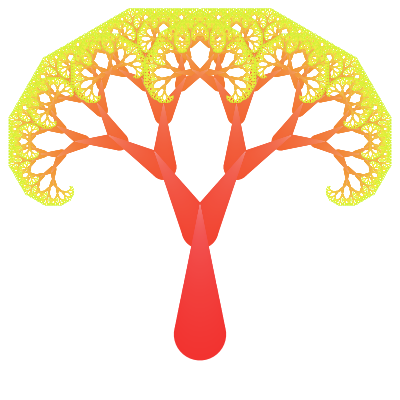
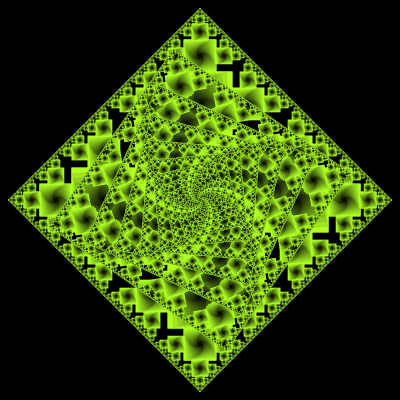
Swap CIRCLE for SQUARE, change the transform from a rotating branch into a spiral, and the same handful of ideas produces something completely different — a crystalline diamond built from squares shrinking and stepping inward:
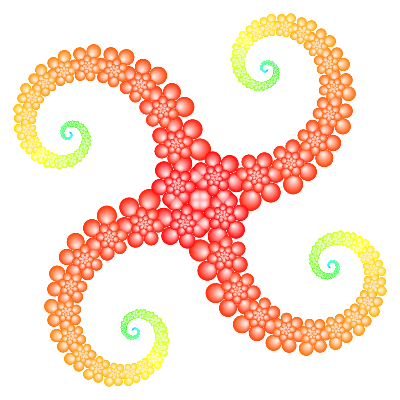
Or a four-armed spiral of shrinking, fading circles that reads as a starfish:
What I like about it is how little code it takes to get somewhere interesting, and how much of the result is discovered rather than designed. You write four short rules, run the renderer, and get something you didn’t quite picture in your head — then you nudge one number (a rotation, a scale factor, a colour delta) and the whole image transforms. It’s closer to tweaking a synth patch than to normal programming: small, legible causes with genuinely surprising effects.
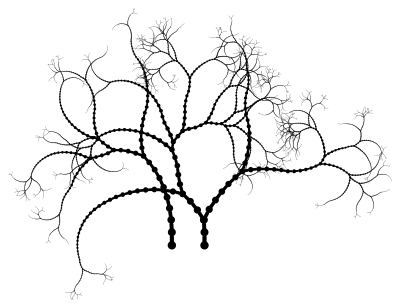
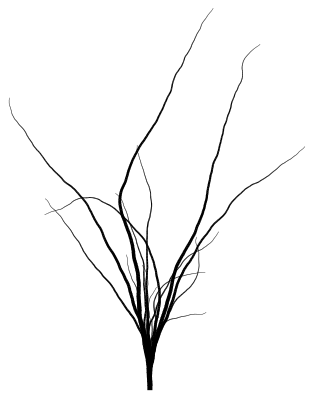
Drop the colour entirely and add some randomness to the branch angle instead of a fixed 30°, and the same “draw a spike, recurse twice” idea stops looking like a fractal and starts looking like an actual plant:
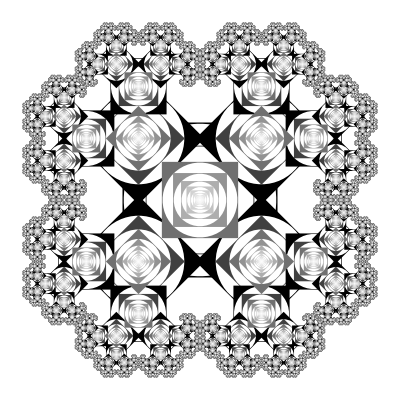
or a whole different rule set, tree grey.cfdg, layers squares and rotations into something closer to a stained-glass kaleidoscope than anything botanical:
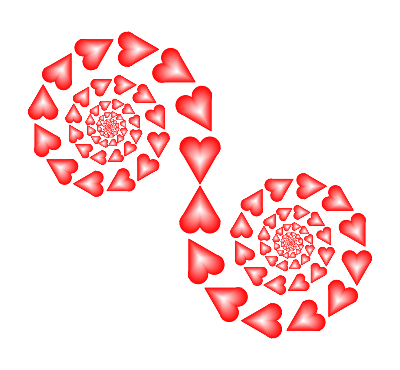
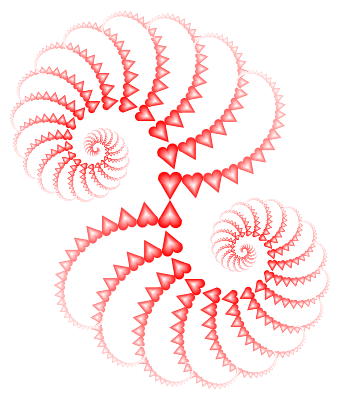
Not everything in the repo is fractal, either. A hearts.cfdg builds a spiral of hearts out of a triangle and two circles per “petal”:
and cards.cfdg reuses that same heart-drawing rule, flipped and combined with triangles, to build the four playing card suits:
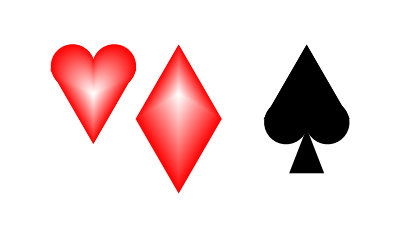
which is a good example of the other satisfying bit — once you have a rule like drawheart, it’s just a function. Reuse it, transform it, compose it into something new.
The plumbing
The creative side is the point, but I still ended up doing normal software things around it, because that’s the itch I can’t leave unscratched. The repo has:
scripts/*.cfdg— the grammar files, one per image.Examples/*.png— matching rendered output, filename-paired with the script that produced it.docker_image/— a multi-stage Dockerfile that compilescfdgfrom source in a build stage and copies only the binary and its runtime libs into the final image, which took the image from ~700MB down to ~140MB.draw.sh— a one-line wrapper so rendering a script is just./draw.sh 1024 fractal_tree.
None of that is necessary to enjoy Context Free Art — the tool has its own bundled editor — but wrapping it in Docker means I can render from any machine without an install step, and keeping scripts and their rendered PNGs paired in git gives me a visual diff of sorts: change a rule, re-render, see exactly what moved.
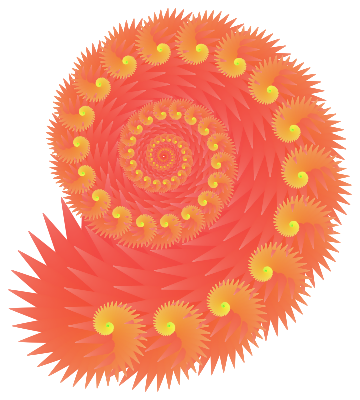
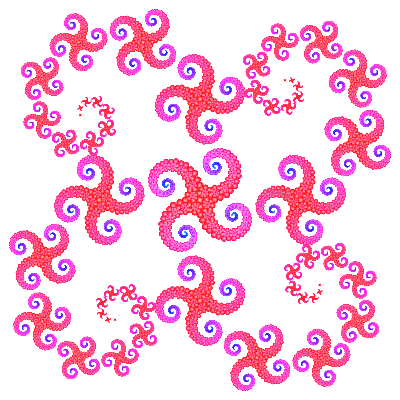
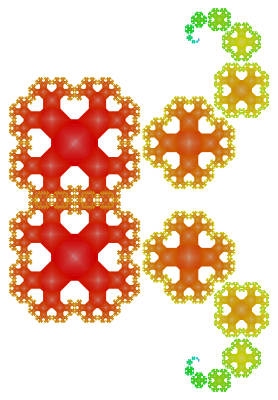
A few more from the collection, because it’s hard to stop once you start nudging parameters — the same handful of tricks (recurse, transform, shift the hue) keeps producing things that don’t look related to each other at all:
Between the tiny recursive grammar and the small pile of build tooling around it, ContextFree is a good reminder that “programming” and “making something creative” aren’t really different activities for me — just the same instinct pointed at a different kind of output.