Musings of an aging computer nerd hitting 0x32

Inktober 2026 19
Inktober 2026 19, Confused
Captain’s log, Day 19
Impact. Then nothing.
I came round hanging in my harness, the deck over my head, the ceiling underfoot. Alarms are screaming but I can’t tell which are real. Smoke in the cockpit. Instruments reading everything at once: climbing, falling, dead.
The lights cut out and I couldn’t tell up from down.
Through the cracked glass: mountains, and a column of smoke rising from the wreck.
Inktober 2026 18
Inktober 2026 18, Flightless
Captain’s log, Day 18
It’s gone. We won, if you can call it that.
The hull is torn open. The power is dead. The ground is coming up fast.
We paid for this in lives I’ll have to name later. Everyone aboard is still breathing. Nobody is leaving.
We are flightless.

New Posts Now Announce Themselves on Bluesky
New posts on this blog now get announced on Bluesky automatically, alongside the Mastodon toots that were already going out. If you’re reading this via a Bluesky link card, that’s the thing working.
It went live on 16 October, with the Inktober “Gangly” post being the first one through, and it’s been quietly doing its job since.
How it works
The whole thing is a GitHub Actions workflow plus a small Python script, with no third-party service in the middle.
Inktober 2026 17
Inktober 2026 17, Contraption
Captain’s log, Day 17
The engineer hasn’t slept. Neither have I.
We have to get rid of the thing. A sealed bulkhead won’t hold it for long.
So the engineer built something: welding mask, oxy-acetylene tanks and torch, deck plating riveted into armour, and a cargo claw for an arm. A contraption. Protection. Hopefully safe.
Somebody has to wear it.
We’re drawing straws…

Inktober 2026 16
Inktober 2026 16, Gangly
Captain’s log, Day 16
Movement in the corridor outside Medical. Gangly. Jerky. Too many joints, none of them bending the right way.
Then the noises: nothing a human throat should make. It was coming from the medical unit, and the unit was meant to be sealed.
I saw it clearly for three seconds. That was enough. Never unsee this. It will live in our nightmares forever.
Inktober 2026 15
Inktober 2026 15, Hooray
Captain’s log, Day 15
The rescue is complete. Against every odd, the crew is home, and for the first time in weeks the cargo hold rings with laughter.
Banners hang from the bulkhead. Glasses are raised. And somehow, impossibly, there are balloons. We are light years from anywhere, and I will never know where they found them.
For one perfect hour, nobody is afraid.
Then the alarm sounds…
Inktober 2026 14
Inktober 2026 14, Lady
Medical log, Day 14
Pod survivor recovered. Unconscious. Vitals steady, which is more than I can say for me.
The rope held. Just. I keep checking the knot.
The crew are calling her “the Lady.” She looks human. Almost. Something about the eyes sits wrong, and nobody will say it out loud.
How did she get into a sealed rescue pod? Nobody launched it.
I don’t know what we’ve brought aboard. We’ll find out when she wakes. If she wakes.
Inktober 2026 13
Inktober 2026 13, Flimsy
Captain’s log, Day 13
Rope takes the strain. We’ve started hauling the unidentified survivor out of the pit, hand over hand, with the engineer on the line.
Then the rope starts to fray. It’s a flimsy old thing, rated for cargo and not for people, and every strand that parts is one fewer between them and the dark.
Nobody says it, but we all hear it. Keep pulling.
Inktober 2026 12
Inktober 2026 12, Toss
Captain’s log, Day 12
Something moved in the pit.
An unidentified survivor in a rescue pod emergency suit, no ID and no comms, just a gloved hand reaching up out of the dark.
Our engineer’s arm has always been good, and the rescue line went out on target. Hauling them up now. Lander crew standing by.

Inktober 2026 11
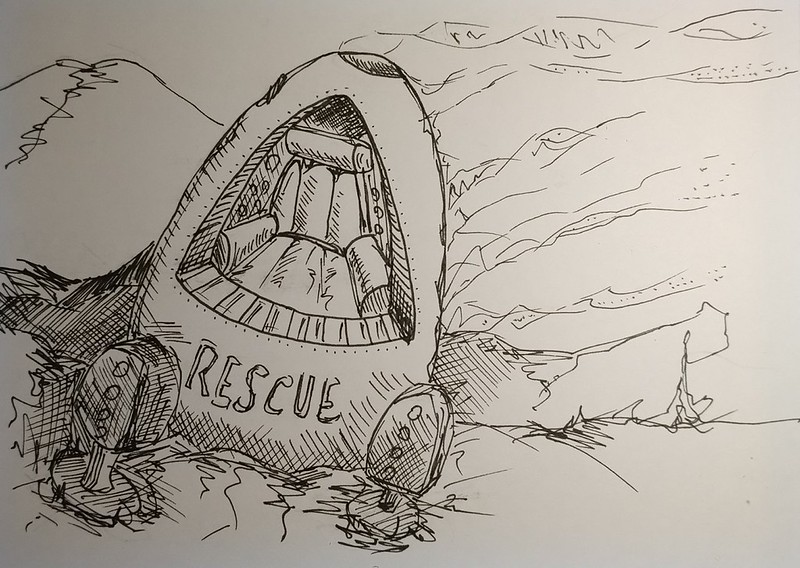
Inktober 2026 11, Rescue
Mission log, Day 11
RESCUE POD TRANSMISSION [AUTO-RELAY, SIGNAL DEGRADED]
…mayd—mayday. Pod touch-do█n confirmed. Landed. Hull ch@rred, aft sect-on b-rnt thr█ugh. Hatch popped on impact, seals gone. Cabin open to the e█terior.
Passenger g0ne. Repeat: passenger GONE. Couch empty, straps cut. No tr_ce. Beacon s-ill ping█ng from the pod.
Air 4% and f█lling. Power 11%. Ne-d re-sc– rescue… resc█e…
[TRANSMISSION ENDS]